What is Stu Cook's net worth?
Stu Cook is an American bass guitarist who has a net worth of $20 million.
Stu Cook is best known as the steady, understated bassist who helped power one of the most influential rock bands of the late 1960s and early 1970s, Creedence Clearwater Revival. While frontman John Fogerty received much of the spotlight as the band's primary songwriter and vocalist, Cook's precise, driving bass lines were a critical part of CCR's unmistakable sound, anchoring hits like "Fortunate Son," "Bad Moon Rising," and "Proud Mary."
As a founding member, Cook contributed to a remarkable run of commercial and critical success that produced multiple platinum albums and a string of enduring singles that remain staples of classic rock radio. After the band's breakup in the early 1970s, Cook stayed active in music through various projects, most notably Creedence Clearwater Revisited, which allowed him to revisit and celebrate CCR's catalog with original drummer Doug Clifford. Though often less visible than some of his peers, Cook's role in shaping one of America's most iconic bands has earned him lasting recognition among musicians and fans alike.
Early Life
Stuart Alden Cook was born on April 25, 1945, in Oakland, California. He grew up in nearby El Cerrito, where he attended school alongside future bandmates John Fogerty, Tom Fogerty, and Doug Clifford. Initially, Cook was not a bassist. He began as a pianist and showed an early interest in classical music before gradually shifting toward rock and roll as the genre exploded in popularity during his teenage years.
Cook's transition to bass came largely out of necessity when the group that would eventually become Creedence Clearwater Revival began to take shape. Like many young musicians of the era, he was largely self-taught, developing a style that emphasized rhythm, groove, and tight synchronization with the drums. This foundation would later become essential to CCR's signature swamp rock sound.
Creedence Clearwater Revival
Cook's professional career took off in the mid-1960s when he joined John Fogerty, Tom Fogerty, and Doug Clifford in a band initially called The Blue Velvets, later renamed The Golliwogs. After several years of modest success and lineup refinement, the group rebranded as Creedence Clearwater Revival in 1967.
Between 1968 and 1972, CCR experienced one of the most intense and productive runs in rock history. The band released seven studio albums in just four years, including "Bayou Country," "Green River," "Willy and the Poor Boys," and "Cosmo's Factory." Cook's bass playing was a key component of the band's sound, providing a clean, propulsive backbone that complemented John Fogerty's guitar and Clifford's drumming.
Unlike many bassists of the era who sought to showcase technical flair, Cook focused on serving the song. His lines were economical but highly effective, helping drive hits like "Down on the Corner," "Travelin' Band," and "Up Around the Bend." This disciplined approach contributed to CCR's reputation for tight, no-nonsense musicianship.
Despite the band's massive success, internal tensions grew, particularly around creative control. John Fogerty's dominance as songwriter and leader created friction with the other members, including Cook. These tensions came to a head during the recording of the 1972 album "Mardi Gras," when Cook and Clifford were given more creative input. The result was a less cohesive album, and the band officially disbanded later that year.
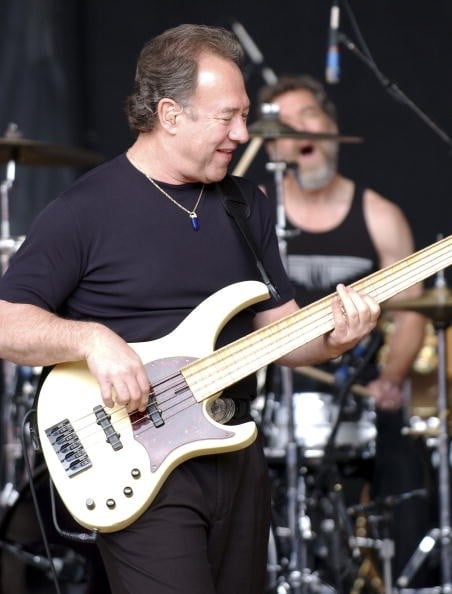
Tim Mosenfelder/Getty Images
Post-CCR Career
Following the breakup of Creedence Clearwater Revival, Cook pursued various musical projects but largely stayed out of the mainstream spotlight. He remained active as a performer and recording artist, working with different groups and occasionally collaborating with former bandmates.
In the 1990s, Cook reunited with drummer Doug Clifford to form Creedence Clearwater Revisited. The project was designed to perform CCR's classic material for live audiences, offering fans a chance to hear the songs played by original members of the band. The group toured extensively and found a receptive audience, particularly among fans who had never seen CCR perform during its original run.
Creedence Clearwater Revisited also became part of a long-running legal and personal dispute with John Fogerty, who objected to the use of the Creedence name. Despite the controversy, Cook and Clifford continued touring for decades, helping keep the band's music alive for new generations.
Musical Style and Legacy
Stu Cook's playing style is often described as understated but essential. Rather than drawing attention to himself, he focused on locking in with the rhythm section and reinforcing the groove of each song. This approach proved highly effective within CCR's stripped-down, roots-oriented sound, which blended rock, blues, country, and swamp influences.
Cook's bass lines are a masterclass in restraint and precision. Songs like "Born on the Bayou" and "Have You Ever Seen the Rain" showcase his ability to create movement and momentum without overcomplicating the arrangement. His work has influenced countless bassists who value feel and timing over flash.
In 1993, Cook was inducted into the Rock and Roll Hall of Fame as a member of Creedence Clearwater Revival, cementing his place in music history. Although he has often been overshadowed by more prominent figures within the band, his contributions remain a vital part of CCR's enduring appeal.
Later Years
In addition to his musical work, Cook has been involved in various business and production ventures over the years, maintaining a connection to the broader entertainment industry. He has also participated in interviews and retrospectives that shed light on CCR's rapid rise and complicated internal dynamics.
Cook eventually stepped back from touring with Creedence Clearwater Revisited, but his legacy continues through the band's timeless catalog. CCR's songs remain among the most played and recognized tracks in rock history, and Cook's role in creating that sound ensures his lasting influence.
While he may not have sought the spotlight, Stu Cook's steady presence and musical discipline helped define one of the most successful American rock bands of all time.
Real Estate
In February 2026, Stu Cook sold a waterfront home in Sarasota, Florida for $7.5 million, marking a substantial gain from the $2.95 million he and his wife, Diana, paid for the property in 2013. The sale price came in below its original $9.97 million listing, but still represented a significant appreciation over the course of their ownership.
The modern residence, located near Siesta Key, spanned approximately 4,559 square feet on a third of an acre and was originally designed by architect Carl Abbott, a member of the Sarasota School of Architecture. Built in 2002 and extensively renovated in 2016, the home featured a sleek, contemporary design with an emphasis on indoor-outdoor living.
The property included four bedrooms and 4.5 bathrooms, along with a large open-concept great room defined by floor-to-ceiling glass walls and sliding doors that opened to expansive water views. Interior highlights included white oak flooring, a marble fireplace, and a chef's kitchen with custom cabinetry and hidden features such as a sliding countertop concealing an induction cooktop or sink.
Upstairs, the primary suite featured a private terrace, sitting area, and flexible wood-paneled partitions for added privacy. Additional amenities included a home gym, elevator, and a dramatic floating staircase with glass railings.
Outside, the home was designed for waterfront living and entertaining, with a travertine pool deck, covered lounge areas, a pool and spa, and a private boat dock equipped with a lift. The combination of architectural pedigree, modern upgrades, and direct water access made the property one of the more notable residential sales in the Sarasota area at the time.
Read more: Stu Cook Net Worth
Comments
Post a Comment