What is Tony Kushner's net worth?
Tony Kushner is an American playwright and screenwriter who has a net worth of $8 million.
Tony Kushner is best known for writing the landmark two-part play "Angels in America," one of the most acclaimed works in modern American theater. The play won the Pulitzer Prize for Drama and multiple Tony Awards, and it established Kushner as one of the most important playwrights of his generation. Beyond the stage, Kushner has had a major second career as a screenwriter, particularly through his collaborations with director Steven Spielberg. He wrote or co-wrote the screenplays for "Munich," "Lincoln," "West Side Story," and "The Fabelmans," earning multiple Academy Award nominations. His work is known for its intellectual ambition, political urgency, moral complexity, humor, and sweeping engagement with American history, Jewish identity, sexuality, power, and social justice.
Early Life
Tony Kushner was born on July 16, 1956, in Manhattan, New York City. His family moved to Lake Charles, Louisiana, when he was a child, and he grew up in a Jewish household in the American South. His parents were both musicians, and Kushner was exposed to theater, music, literature, and political discussion from an early age.
He attended Columbia University, where he earned a bachelor's degree in medieval studies. He later studied directing at New York University's Tisch School of the Arts. After graduate school, Kushner began working in New York theater as a writer, director, and educator, gradually developing the bold, politically engaged style that would define his career.
Theater Career
Kushner's early stage work included "A Bright Room Called Day," a politically charged play that connected the rise of Nazism in 1930s Germany with conservative politics in the United States during the Reagan era. The play established many of the themes that would recur throughout his career, including fascism, moral responsibility, left-wing politics, and the ways history presses on the present.
His breakthrough came with "Angels in America: A Gay Fantasia on National Themes," a two-part epic consisting of "Millennium Approaches" and "Perestroika." Set largely during the AIDS crisis of the 1980s, the play combines realism, fantasy, religion, politics, sexuality, illness, and American mythology. It became a defining work of late 20th-century theater and won the Pulitzer Prize for Drama. "Millennium Approaches" and "Perestroika" both won the Tony Award for Best Play.
Kushner followed "Angels in America" with a wide range of ambitious stage works, including "Slavs!," "Homebody/Kabul," and "Caroline, or Change," a musical written with composer Jeanine Tesori. "Caroline, or Change," set in Louisiana during the civil rights era, drew partly on Kushner's own Southern childhood and became one of his most admired works. He has also translated and adapted plays, including works by Bertolt Brecht and Pierre Corneille.
Film and Television Work
Kushner's screen career expanded significantly through his partnership with Steven Spielberg. He earned an Academy Award nomination for co-writing "Munich," Spielberg's 2005 historical thriller about the aftermath of the 1972 Munich Olympics massacre. The film marked Kushner's arrival as a major screenwriter and showed his ability to translate politically complex historical material into cinema.
He reunited with Spielberg for "Lincoln," a historical drama focused on Abraham Lincoln's fight to pass the 13th Amendment. Kushner's screenplay earned him another Academy Award nomination and was widely praised for its intelligence, density, humor, and attention to political process. The film starred Daniel Day-Lewis, who won the Oscar for Best Actor.
Kushner later wrote the screenplay for Spielberg's film adaptation of "West Side Story." Rather than simply updating the original musical, Kushner reworked character histories, sharpened the story's social context, and gave the material a fuller sense of New York's racial, ethnic, and urban tensions. He also co-wrote "The Fabelmans," Spielberg's semi-autobiographical film about a young aspiring filmmaker and his family. The film earned several Academy Award nominations and further cemented Kushner's status as one of Spielberg's most trusted creative collaborators.
For television, Kushner adapted "Angels in America" into the acclaimed HBO miniseries directed by Mike Nichols. The production starred Al Pacino, Meryl Streep, Emma Thompson, Mary-Louise Parker, Jeffrey Wright, and Justin Kirk. It won major Emmy and Golden Globe awards and introduced Kushner's most famous work to an even larger audience.
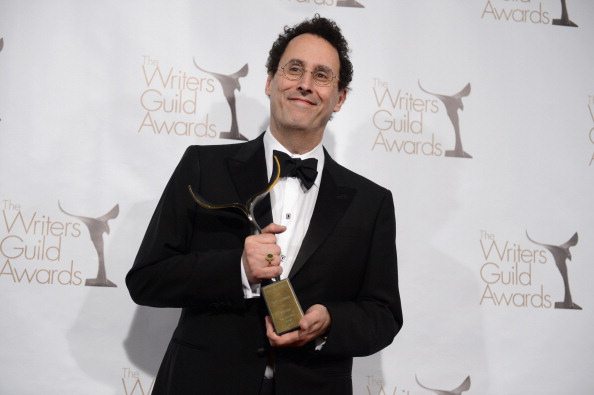
Tony Kushner / Jason Kempin/Getty Images
Writing Style and Themes
Kushner's work is known for its scale, intellectual density, and moral seriousness. His plays often combine politics, theology, history, comedy, and deeply emotional personal stories. He is especially associated with long, rhetorically rich speeches and characters who argue passionately about ethics, identity, love, illness, power, and the possibility of change.
His writing frequently explores Jewish history and identity, LGBTQ life, American politics, capitalism, socialism, racism, and the failures and promises of democracy. Even when his work is angry or tragic, it often contains humor, tenderness, and a belief in human connection.
Awards and Honors
Kushner has received many of the highest honors available to an American writer. "Angels in America" won the Pulitzer Prize for Drama and multiple Tony Awards. His screenplays have earned Academy Award nominations, and his television adaptation of "Angels in America" won major Emmy recognition.
He has also received the National Medal of Arts and numerous lifetime achievement and literary honors. His body of work spans theater, film, television, essays, adaptations, and children's literature, making him one of the rare contemporary American dramatists to achieve major influence across multiple mediums.
Personal Life
Tony Kushner is openly gay and has long been associated with LGBTQ advocacy, progressive politics, and public activism. In 2003, he married journalist and editor Mark Harris. Their wedding was among the first same-sex commitment ceremonies to be featured in the New York Times "Vows" column.
Kushner has remained politically outspoken throughout his career, frequently speaking on issues related to democracy, civil rights, war, labor, inequality, and LGBTQ rights. His public voice, like his writing, reflects a deep belief that art and politics are inseparable parts of civic life.
Read more: Tony Kushner Net Worth
Comments
Post a Comment