What was Lou Gehrig's Net Worth and Salary?
Lou Gehrig was an American professional baseball player who had a net worth of $3 million. That's the same as around $7 million in today's dollars after adjusting for inflation.
Considered one of the greatest baseball players in history, Lou Gehrig played 17 seasons in MLB with the New York Yankees from 1923 to 1939 and won six World Series titles, an AL batting championship, two AL MVP awards, and a Triple Crown. His career ended abruptly when he was diagnosed with the neuromuscular illness ALS, from which he passed away in 1941.
Salary History
Between 1923 and 1939, Lou Gehrig earned a total of $361,500 in salary. That's the same as roughly $7.1 million in today's dollars after adjusting for inflation.
Early Life and Education
Lou Gehrig was born Heinrich Ludwig Gehrig on June 19, 1903 in the Manhattan borough of New York City. He was the second of four children of German immigrants Anna and Heinrich, the former a maid and the latter a sheet-metal worker who struggled with alcoholism. Gehrig was the only one of his siblings to live beyond childhood, as his two sisters died early from whooping cough and measles and his brother passed away in infancy. As a youth, he was educated at PS 132 in Washington Heights and Commerce High School. After graduating from high school in 1921, Gehrig attended Columbia University, where he studied engineering and played both baseball and football for the Columbia Lions. However, flustered by the schoolwork, he left after two years.
MLB Career
Gehrig signed with MLB's New York Yankees partway through the 1923 season. He saw limited playing time in his first two seasons before breaking out in 1925 with a .295 batting average, 20 home runs, and 68 RBI in 126 games. Gehrig would go on to play in every Yankees game until April 30, 1939, setting a record for the most consecutive games played in MLB, at 2,130. Following his strong 1925 season, he had an even more impressive 1926, batting .313 with 112 RBI and appearing in his first World Series. Ultimately, the Yankees lost to the St. Louis Cardinals. In 1927, Gehrig had what is considered one of the greatest seasons by a batter in MLB history, hitting .373 with 47 home runs and a then-record 175 RBI. Named the AL MVP, he helped lead the Yankees to a four-game sweep of the Pittsburgh Pirates in the 1927 World Series. Gehrig led the AL in RBI again in 1928 en route to a second consecutive World Series title, this time sweeping the Cardinals in four games. He led the AL in RBI for a third time in 1930 and a fourth time in 1931, and led the AL in home runs for the first time in the latter year. In 1932, the same year he became the first MLB player in the 20th century to hit four home runs in a single game, Gehrig won his third World Series with the Yankees.
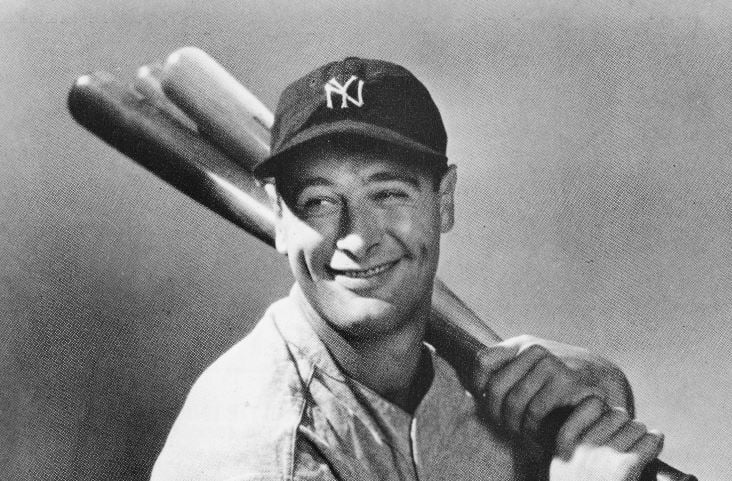
In 1933, Gehrig earned his first of seven consecutive All-Star selections. The following year, he became the second MLB player to reach 300 home runs, after his teammate Babe Ruth, and won the batting championship with a .363 batting average. Gehrig also led the AL in home runs (49) and RBI (166), garnering the Triple Crown. He led the AL in home runs for the third and final time in 1936, when he was also named AL MVP for the second and final time and helped the Yankees win another World Series. Gehrig and the Yankees won two more consecutive World Series titles in 1937 and 1938. His career ended abruptly in the spring of 1939 when he voluntarily removed himself from the Yankees lineup due to declining performance on the field. Gehrig ended up retiring at the age of 36. Two weeks after his retirement, he gave his famous speech at an appreciation day in his honor at Yankee Stadium, claiming he was the "luckiest man on the face of the earth."
Getty
Personal Life
Gehrig had difficulty with romantic relationships in large part due to an overbearing mother with whom he lived until he was 30. In 1900, he married his first wife, Christina, who was 14 years his junior. He married his second wife, Eleanor Twitchell, in 1933.
Illness and Death
After struggling with fatigue and other symptoms in 1938, Gehrig was diagnosed with the neuromuscular illness ALS in mid-1939. On the morning of June 2, 1941, he passed away at his home in the Bronx from complications of the disease. Gehrig's ashes were locked into a crypt in Kensico Cemetery in Valhalla, New York; the remains of his wife Eleanor were later interred alongside his after her passing in 1984.
Read more: Lou Gehrig Net Worth
Comments
Post a Comment