When Pablo Picasso died on April 8, 1973, he left behind one of the most valuable personal art collections in history.
Inside Picasso's homes and studios were nearly 2,000 paintings, more than 1,200 sculptures, thousands of drawings, tens of thousands of prints, thousands of ceramic works, 150 sketchbooks, copperplates, tapestries, manuscripts, photographs, and personal papers. He also owned five properties, millions of dollars in cash and gold, a portfolio of stocks and bonds, and works by other major artists, including Henri Matisse.
Picasso had spent more than seven decades producing art and carefully holding on to much of it. Unlike countless famous artists who died poor and only became valuable afterward, Picasso was internationally famous and extremely wealthy during his lifetime. He understood perfectly well that his paintings were worth enormous sums.
But he neglected one fairly important detail:
Pablo Picasso did not leave a will.
There were no instructions explaining who should receive which paintings. There was no clear plan for dividing the houses, copyrights, reproduction rights, cash, gold, or securities. There was not even an authoritative master inventory of everything Picasso owned.
What followed was a six-year legal, financial, and logistical nightmare involving Picasso's widow, his children, his grandchildren, dozens of lawyers and experts, the French government, and approximately 45,000 works of art.
Picasso belongs to a surprisingly long list of famous people who died without a conventional will. Prince, Howard Hughes, Bob Marley, and Martin Luther King Jr. also died intestate, leaving courts and relatives to determine what happened to their assets. Aretha Franklin left several handwritten documents, including one discovered between couch cushions, producing a lengthy fight over which version represented her final wishes.
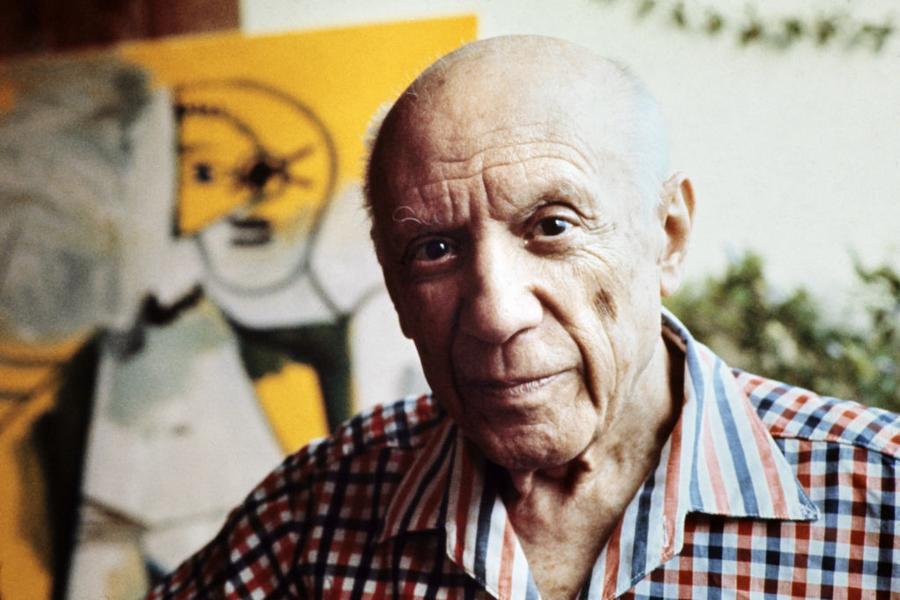
RALPH GATTI/AFP via Getty Images
The 45,000-Piece Inventory
Picasso was 91 years old when he died at his home in Mougins, France. He had continued working almost until the end of his life, filling his properties with decades' worth of paintings, sculptures, drawings, ceramics, prints, notebooks, and unfinished projects.
The final estate inventory reportedly included:
- 1,885 paintings
- 1,228 sculptures
- 7,089 drawings
- Approximately 30,000 prints
- 3,222 ceramic works
- 150 sketchbooks
That was in addition to illustrated books, copperplates, tapestries, archival materials, and Picasso's personal collection of works by other artists.
Picasso's son Claude later joked that the family would have needed to rent the entire Empire State Building to store everything in one place.
The physical art was only part of the fortune. Picasso also reportedly left approximately $4.5 million in cash and $1.3 million in gold, equal to tens of millions of dollars today. He owned two châteaux and three other homes, along with an investment portfolio containing stocks and bonds.
Then there were the less tangible assets. Picasso's heirs would control the copyrights to his works, reproduction fees, exhibition permissions, licensing opportunities, and commercial uses of his name, image, and signature. Those rights would eventually develop into a business worth many millions of dollars on their own.
Before anyone could divide the fortune, however, the family had to determine exactly who was legally entitled to inherit it.
Picasso's Complicated Family
Picasso was married twice and had four children with three different women.
His eldest child, Paulo, was born during Picasso's marriage to Russian-Ukrainian ballet dancer Olga Khokhlova. Picasso and Olga separated in the 1930s but never divorced because Picasso did not want to divide his property with her.
Picasso later had a daughter, Maya, with Marie-Thérèse Walter. He also had two children, Claude and Paloma, with artist and writer Françoise Gilot.
At the time of Picasso's death, he was married to his second wife, Jacqueline Roque.
The family relationships were deeply strained. Picasso had never married the mothers of Maya, Claude, or Paloma, and the legal status of those children had to be resolved under French inheritance law. Claude and Paloma had already begun proceedings to establish their legal rights as Picasso's children and were formally recognized as heirs in 1974.
The hostility extended far beyond paperwork. When Picasso was buried, Jacqueline and Paulo were reportedly the only immediate family members permitted to attend the funeral. Several of Picasso's other children and grandchildren were excluded.
Paulo died in 1975, just two years after his father and before the estate had been fully divided. His inheritance rights then passed through his own estate, benefiting his children, Marina and Bernard.
The dispute therefore involved Picasso's widow, his surviving children, and descendants of a son who had died during the settlement process. These were not relatives who trusted one another or shared a common vision for Picasso's legacy. They were members of several competing branches of a fractured family, each trying to secure a fair portion of an estate containing thousands of objects whose values could vary by millions of dollars.
How Do You Divide 45,000 Works Of Art?
Dividing a normal estate might involve selling a house, closing bank accounts, and distributing money among the heirs.
Picasso's estate was different.
Every painting, sculpture, drawing, print, ceramic work, and sketchbook had to be located, catalogued, authenticated, and valued. Experts had to determine which pieces were genuine finished works, which were studies, and which were unfinished projects. Picasso's homes, financial assets, personal possessions, copyrights, and licensing rights also had to be assessed.
More than 50 lawyers, appraisers, cataloguers, government officials, and other specialists reportedly became involved.
Even after the inventory was completed, the heirs faced a nearly impossible question: How could the collection be divided fairly?
One heir might receive a large number of drawings, while another received a smaller number of paintings worth far more money. A work considered secondary in the 1970s could become enormously valuable decades later. Several pieces from the same period might appear comparable to an appraiser but have very different importance within Picasso's career.
The family reportedly held approximately 60 meetings as it attempted to reach an agreement. Some sessions descended into bitter personal arguments. At one meeting, an heir reportedly told another that it seemed impossible they had come from the same father.
The entire settlement process took six years and cost approximately $30 million in legal fees, appraisal expenses, administrative costs, and other professional charges.
How Much Was Picasso's Estate Worth?
A court-appointed expert eventually valued Picasso's estate at approximately $250 million.
For comparison, the estate of fellow art-world icon Andy Warhol was eventually appraised at $220 million following his death in 1987. Picasso's estate was officially valued at an even higher amount despite being assessed years earlier, before the explosive growth of the global market for blue-chip art.
Adjusted only for inflation, $250 million in 1980 would be worth roughly $1 billion today. But that calculation does not come close to reflecting what Picasso's collection would actually be worth in the modern art market.
Even at the time, some experts believed the collection's true market value was already in the billions. The official appraisal had to assign values to tens of thousands of works without flooding the market or assuming that every piece could be sold at the same time.
Picasso's prices have risen dramatically since then. In 2015, his painting "Les Femmes d'Alger (Version O)" sold for $179.4 million. Other Picasso paintings have sold for more than $100 million, while dozens have commanded prices in the tens of millions.
That means a relatively small group of masterpieces from Picasso's estate could now be worth more than the entire official 1980 appraisal.
The estate also contained thousands of lower-priced works, but even Picasso drawings, prints, and ceramics can sell for significant sums. Taken together, the collection Picasso left behind would almost certainly be worth several billion dollars in today's market.
The Tax Bill That Created The Musée Picasso
The heirs faced another enormous problem: inheritance taxes.
A collection might be worth hundreds of millions of dollars on paper, but paintings cannot be used to write a check to the French government. Selling enough works to cover the tax bill could have required the family to place hundreds or thousands of Picassos on the market, potentially depressing prices and permanently scattering the collection.
Fortunately for the heirs, France had recently created a solution.
A 1968 law allowed taxpayers to satisfy inheritance obligations by transferring works of exceptional artistic or historical importance to the French government. This process, known as a "dation," enabled Picasso's heirs to pay much of the estate's tax bill with artwork rather than cash.
French curators were allowed to select works from throughout Picasso's career. The government did not receive a pile of unwanted leftovers. It received hundreds of major pieces chosen to represent the full range of Picasso's development.
The original transfer reportedly included:
- 203 paintings
- 158 sculptures
- 88 ceramic works
- Nearly 1,500 drawings
- More than 1,600 prints
- 33 sketchbooks
Those works became the foundation of the Musée Picasso in Paris, which opened in 1985.
The museum's holdings later expanded through additional donations and inheritance-tax arrangements, including transfers following Jacqueline Picasso's death and another involving the estate of Maya Ruiz-Picasso.
Today, the Musée Picasso owns more than 5,000 works by the artist, along with an enormous archive of photographs, correspondence, manuscripts, and personal documents. The museum exists largely because Picasso died without a conventional estate plan and his heirs needed a way to pay the resulting tax bill.
The Picasso Name Becomes A Business
Dividing the physical artwork did not end the family's financial relationship.
The heirs still jointly controlled valuable intellectual property associated with Picasso. Companies, publishers, museums, filmmakers, and advertisers needed permission to reproduce his artwork or commercially use his name, image, and signature.
In 1995, Claude Picasso created the Picasso Administration to manage those rights on behalf of the family. The organization authorizes reproductions and exhibitions, negotiates licensing agreements, monitors commercial uses of the Picasso name, pursues counterfeiters, and helps combat forged or stolen works.
One of the most controversial licensing agreements came from the automobile industry.
In the late 1990s, Citroën secured permission to use the Picasso name and a version of the artist's signature on a line of compact vehicles. The automaker reportedly paid approximately $20 million for the initial rights and continued paying royalties afterward.
The Citroën Xsara Picasso and later Picasso-branded models became highly successful, selling millions of vehicles. Not every family member approved. Picasso's granddaughter Marina publicly objected to attaching her grandfather's name to an ordinary car, but other heirs supported the arrangement.
The Picasso Administration has also approved carefully selected deals involving luxury goods, books, exhibitions, and reproductions. At the same time, it spends substantial resources fighting unauthorized merchandise, fake artwork, and commercial uses that the heirs believe damage Picasso's reputation.
Claude managed the organization for decades. Paloma Picasso succeeded him as administrator in 2023, shortly before Claude's death.
A Multibillion-Dollar Fortune With No Instructions
Picasso's heirs ultimately emerged from the dispute as extremely wealthy people. They received enormous collections of artwork and stakes in the continuing business built around Picasso's creative legacy.
Some also built independent fortunes. Paloma Picasso became an internationally successful jewelry and fashion designer, creating products for Tiffany & Co. and launching a fragrance and accessories business. Her career, combined with her Picasso inheritance, made her one of the wealthiest members of the family.
But the inheritance also brought decades of conflict. Family members disagreed over licensing, authentication, sales, museum loans, and the proper way to protect Picasso's reputation. Individual branches of the family developed different relationships with the art they inherited. Some kept large private collections, while others sold works or donated pieces to museums.
Picasso had spent his entire adult life controlling his art. He determined what he created, what he sold, what he kept, who he painted, and how he wanted the world to see him.
Yet when it came to the largest collection he ever assembled—his own estate—he left no instructions at all.
The result was six years of negotiations, approximately $30 million in settlement expenses, a permanent division within one of the art world's most famous families, and a tax arrangement that created one of France's great museums.
Picasso's failure to write a will was an extraordinary act of financial negligence. It was also, unintentionally, one of the most consequential decisions in the history of modern art.
Read more: When Pablo Picasso Died, He Left Behind Billions Of Dollars Worth Of Art — And No Will
Comments
Post a Comment