I have said this before, and I'll say it again: If you're already extremely famous and would like to become dramatically richer, there is a pretty compelling three-step process.
- Step 1: Become a huge celebrity.
- Step 2: Launch a liquor brand, preferably tequila.
- Step 3: Sell the brand to a giant alcohol conglomerate for an obscene amount of money.
Today, everybody seems to understand the formula.
- George Clooney and Rande Gerber launched Casamigos in 2013 and sold it four years later for as much as $1 billion.
- Kendall Jenner has 818.
- Dwayne "The Rock" Johnson has Teremana.
- Michael Jordan has Cincoro.
- Mark Wahlberg has Flecha Azul.
- Kevin Hart has Gran Coramino.
- Bryan Cranston and Aaron Paul have Dos Hombres.
At this point, being a celebrity without your own premium agave spirit almost feels irresponsible. But that wasn't always the case. Decades before the celebrity-tequila-fortune process became standardized, there was Sammy Hagar. Sammy essentially invented the modern celebrity alcohol brand playbook. And the craziest part is that he seems to have stumbled into it almost completely by accident. Or, to be more specific, he WOBBLED into it.
Before The Tequila, There Was Cabo
Sammy Hagar discovered Cabo San Lucas long before it became the luxury vacation destination it is today. He bought a condo there in 1981, when he later recalled that the town had only a handful of hotels and many businesses didn't even have telephones or air conditioning. He fell in love with the place and started imagining a tequila bar where he could hang out, drink and play music whenever he escaped to Mexico.
It was during those early Cabo years that Hagar came up with the phrase that would eventually become the name of his entire business empire. According to Hagar, back in the day, he was in Cabo and saw a local guy who had partied a little too hard. This guy was trying to walk but was very unsteady and actually fell into a fence. Sammy saw him and thought to himself, "That guy is doing the Cabo Wobble."
"Cabo Wobble" eventually became "Cabo Wabo." Hagar liked the phrase enough to turn it into a song. By then, he had become the lead singer of Van Halen, replacing David Lee Roth in 1985, and "Cabo Wabo" appeared on Van Halen's 1988 album "OU812." Two years later, Sammy turned the song title — and the phrase inspired by an over-served guy crashing into a fence — into an actual place.
Cabo Wabo Cantina opened in Cabo San Lucas in April 1990. Sammy brought his three Van Halen bandmates — Eddie Van Halen, Alex Van Halen and Michael Anthony — into the project as partners, and the band performed at the grand opening. The place was enormous by Cabo standards at the time, with a restaurant, nightclub and performance space built around exactly the kind of lifestyle Sammy enjoyed: beaches, live music, Mexican food and copious amounts of tequila. Presumably, on a successful night, more than a few customers would leave doing their own Cabo Wobble.
Unfortunately, there was one immediate problem: Cabo Wabo was a financial disaster. The business struggled, management was a mess and Hagar's bandmates eventually wanted out. Sammy ultimately bought out Eddie, Alex and Michael and took control of the operation himself. He later described the early Cabo Wabo years as disastrous, but after reorganizing the business with partner Marco Monroy, the cantina eventually became what Hagar called a "gold mine."
His timing was spectacular. Cabo San Lucas exploded as a tourist destination, and Cabo Wabo became one of its most recognizable attractions. Sammy had inadvertently created something much more valuable than a celebrity restaurant. He had created an entire lifestyle brand, and pretty soon that lifestyle brand needed its own tequila.
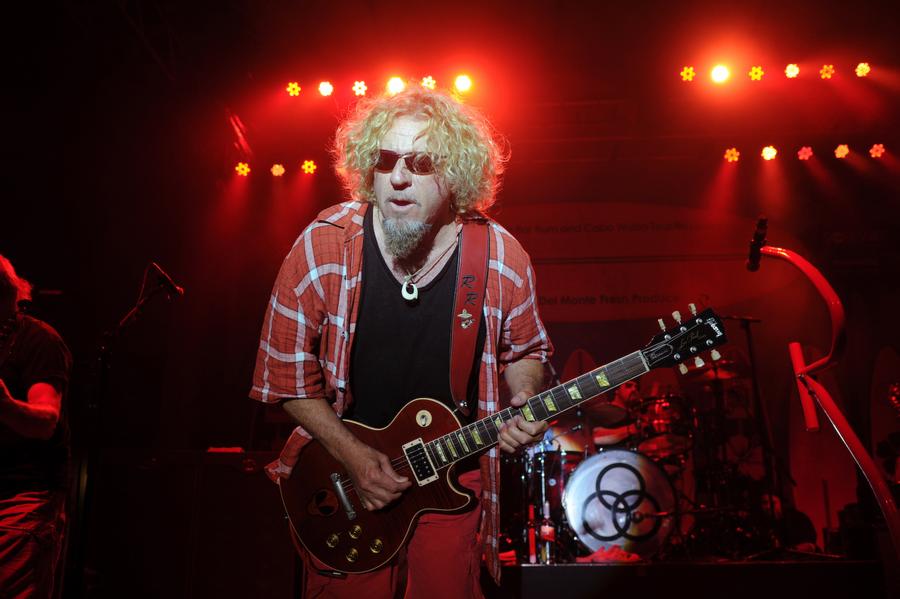
Larry Marano/Getty Images
Cabo Wabo Tequila
During his years traveling around Mexico, Hagar was introduced to high-end handmade tequila that was nothing like the cheap shots many Americans associated with the liquor at the time. He became obsessed with the good stuff and decided he wanted Cabo Wabo Cantina to have a premium house tequila of its own.
That distinction is important. Cabo Wabo Tequila wasn't initially conceived as a giant consumer brand or as some calculated celebrity side hustle that Sammy hoped to flip to a liquor conglomerate. He simply wanted an excellent tequila to serve at his restaurant. In 1996, Cabo Wabo Tequila was born.
Then customers started asking a very useful question: Where can I buy a bottle? What began as a house tequila slowly expanded beyond the walls of the cantina, eventually reaching liquor stores across the United States. Sammy suddenly had a real consumer products company on his hands.
This is where Hagar accidentally stumbled onto the secret that would eventually fuel the entire celebrity alcohol boom. Most new liquor companies have to spend enormous amounts of money convincing consumers to notice them. Sammy Hagar already had millions of consumers paying money to look directly at him.
Sammy Was The Marketing Budget
Hagar promoted Cabo Wabo everywhere. He wore the shirts, talked about the tequila in interviews, integrated the Cabo lifestyle into his concerts and generally behaved like a walking advertisement for the brand. But unlike a conventional company spending millions on television commercials and magazine ads, Sammy's promotional platform was also his day job.
Years later, Hagar explained the advantage in remarkably modern terms. A startup liquor brand might need to spend $5 million or $10 million a year on marketing, while he could promote Cabo Wabo in front of thousands of people every night simply by going on tour. Instead of paying to assemble an audience, his audience was paying him.
There may be no better illustration of Sammy's commitment to the brand than what happened before Van Halen's 2004 reunion tour. According to Hagar, the band objected to him wearing Cabo Wabo shirts onstage. So, on the day of the first show, Sammy got the Cabo Wabo logo tattooed on his arm and performed in short sleeves.
That's not an endorsement deal. That's vertical integration.
That basic advantage is now obvious. Kendall Jenner can expose 818 to hundreds of millions of social media followers. The Rock can put Teremana in an Instagram post and instantly reach an enormous audience. Sammy Hagar was doing the analog version of that in the 1990s.
140,000 Cases
By 2006, Cabo Wabo was selling more than 140,000 cases per year. That's the number that really puts Sammy's accomplishment into perspective, especially when you compare Cabo Wabo with the celebrity tequila brands that followed.
When George Clooney and his partners sold Casamigos to Diageo in 2017 for a deal worth as much as $1 billion, the brand was reportedly on pace to move around 170,000 cases that year. And when Kendall Jenner launched 818 in 2021, her brand reportedly moved an astonishing 136,000 cases in its first seven months.
Obviously, a case of tequila sold in 2006 is not financially identical to a case sold in 2017 or 2021. Pricing, margins, growth rates, distribution, brand momentum and overall market conditions matter enormously when valuing a spirits company. But those numbers show that Cabo Wabo wasn't some novelty tequila kept alive by Van Halen fans. Sammy had built a legitimate national spirits brand with serious volume.
And in 2007, one of the biggest liquor companies in the world decided it wanted in.
The $100 Million Valuation
In May 2007, Italian beverage giant Gruppo Campari announced that it had reached a deal to acquire 80% of Cabo Wabo Tequila for $80 million in cash. Do some extremely advanced multiplication and division, and that purchase price gave Cabo Wabo a valuation of roughly $100 million.
Just stop and appreciate how crazy that was at the time. This was six years before George Clooney launched Casamigos, more than a decade before The Rock launched Teremana and nearly 14 years before Kendall Jenner launched 818. Instagram didn't exist. The phrase "celebrity tequila brand" didn't conjure up an entire shelf at your local liquor store.
Yet Sammy Hagar had somehow created a tequila company worth nine figures.
Campari's logic was straightforward. Cabo Wabo had become one of the fastest-growing premium tequila brands in the United States, but Hagar needed the kind of global distribution infrastructure that a major spirits company could provide. Sammy later summed up the dilemma using a music analogy: If you've got a hit record, eventually you need a major distributor to get it to the entire world.
Importantly, Sammy didn't sell the whole company immediately. Campari bought 80%, while Hagar and his partners retained the remaining 20%, giving them the opportunity to participate in whatever happened next.
The Second Payday
The original agreement gave Campari options to acquire the remaining 20% in later years. Instead, the two sides accelerated the process, and in July 2010 Campari purchased the final stake for approximately $11 million.
The agreement also included an additional earn-out based on Cabo Wabo's future sales volume. Campari initially estimated that payment at approximately $4 million. Combined with the original $80 million deal, the transactions put the total potential consideration for Cabo Wabo at roughly $95 million.
Tequila Made Sammy More Money Than Van Halen
Perhaps the most remarkable financial detail in this entire story is something Hagar himself has acknowledged over the years: Cabo Wabo and his related businesses ultimately made him more money than his music career with Van Halen.
Consider what that means. Sammy wasn't some temporary replacement singer who spent a few months touring on somebody else's catalog. From 1985 through 1996, Van Halen released four studio albums with Hagar as lead singer — "5150," "OU812," "For Unlawful Carnal Knowledge" and "Balance" — and every single one reached #1 on the Billboard 200. The band sold millions of albums and filled arenas around the world.
But being the singer in an enormously successful rock band and owning equity in a valuable company are two very different ways to get rich. Van Halen's money had to flow through band members, record companies, managers, agents, promoters, touring expenses and countless other participants. When somebody wanted to buy Cabo Wabo, Hagar owned a major piece of the actual asset being purchased.
That's the central financial lesson of Sammy's story. Fame can make you rich, but using fame to build something you actually own can make you much richer.
And Then He Started Another Tequila Company
You might assume that after turning one tequila company into a roughly $100 million brand, Sammy would take the win and leave the agave business alone. That would severely underestimate Sammy Hagar's enthusiasm for tequila.
After selling Cabo Wabo, Hagar launched Sammy's Beach Bar Rum and continued expanding his restaurant and hospitality businesses. Then he eventually came right back to tequila. In 2019, Sammy teamed up with his friend Guy Fieri on Santo Spirits, which today sells a lineup of premium tequilas as well as a tequila-mezcal blend called Mezquila.
There is something wonderfully circular about that. The guy who helped pioneer the celebrity tequila business eventually found himself operating in a market overflowing with celebrity tequila companies inspired by essentially the same playbook he helped create.
And Cabo Wabo worked in the first place because the product never felt randomly attached to Sammy Hagar. Cabo, loud music, parties and tequila were already part of his public persona. Long before "authenticity" became a mandatory line in every celebrity-brand pitch deck, Sammy was simply selling a bottle that felt like an extension of Sammy.
Decades later, Hollywood is still trying to do exactly the same thing.
Read more: Sammy Hagar's Accidental $100 Million Tequila Empire Started With A Guy Falling Into A Fence
Comments
Post a Comment